

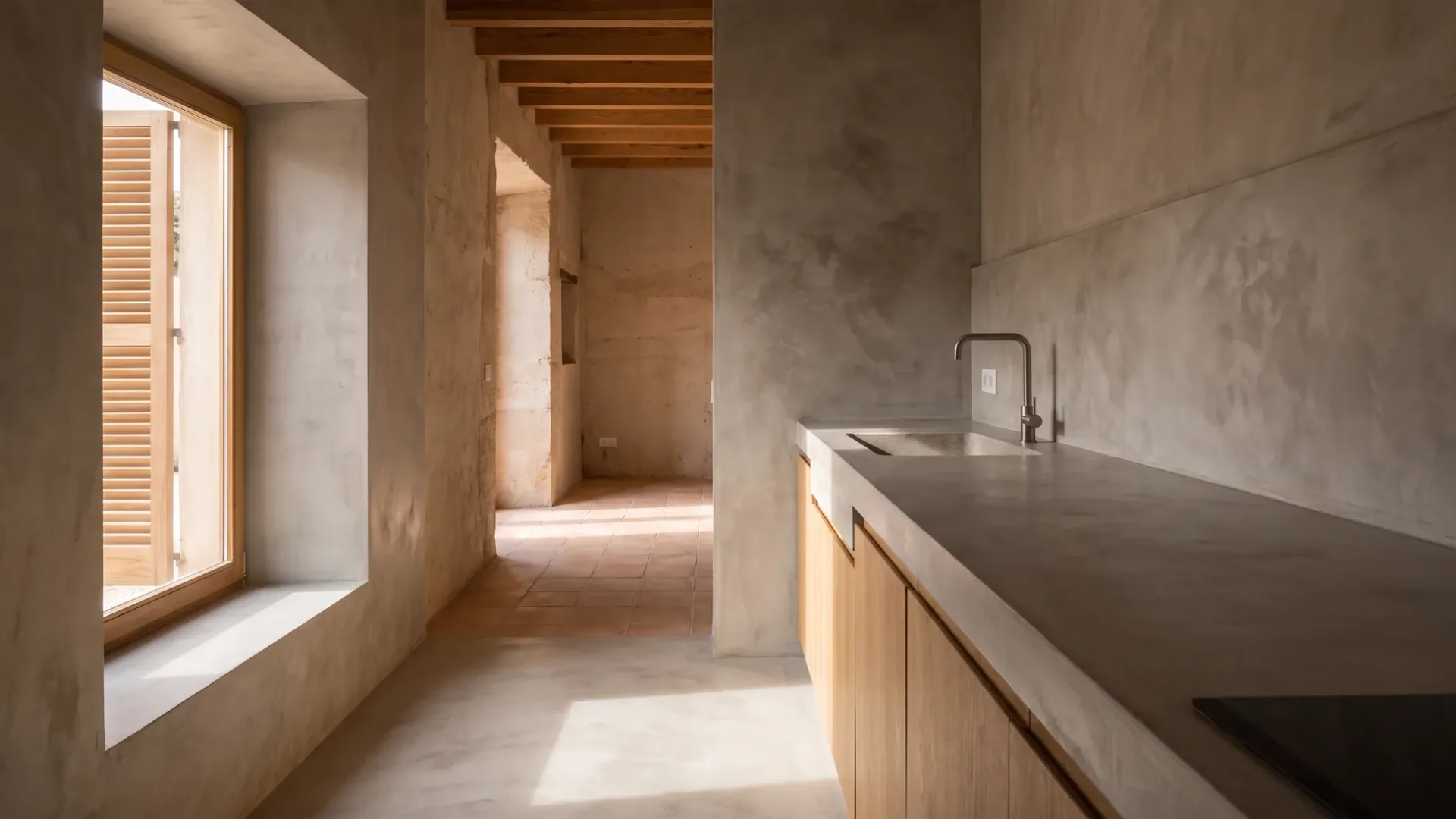
Microcement Kitchens in Mallorca
Microcement is a thin, hand-applied cement finish that goes over almost any sound surface and leaves no joints. In a kitchen it can be the worktop, the splashback, the walls and the floor at once, in one colour, with the soft variation a trowel leaves behind. It is Mediterranean and contemporary at the same time, and it depends more on the applicator than any other finish on this site. Describe the kitchen and we pass the request to kitchen companies and kitchen specialists that work with it.
request describes the job
companies see it
for you, always
obligation to accept
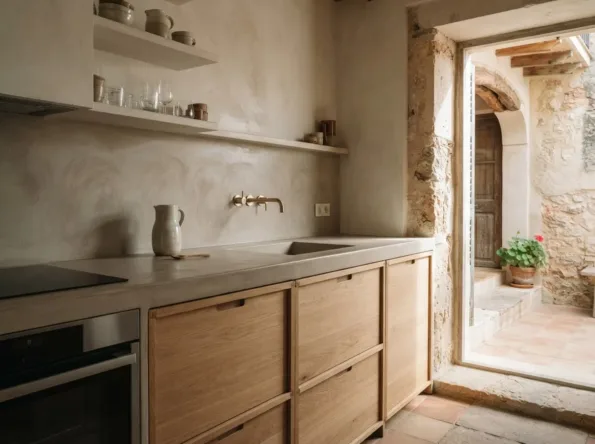
What defines a microcement kitchen
The absence of joints. A microcement worktop runs into the splashback and up the wall without an upstand; a microcement floor runs under the units and out through the door; an island wrapped in it reads as one cast block. The room becomes surfaces rather than components, which is what gives the style its calm.
Then the hand. Microcement is trowelled, and the clouding and the faint marks of the application are the finish. No two rooms are the same and no two applicators produce the same surface, which is why the choice of who does it is the choice of what you get.
And the colour, which is anything the pigment allows and is usually a warm grey, a sand, a stone or an off-white. It takes the light the way plaster does, and in a room that opens onto a terrace it changes through the day.
The elements, one by one
- Worktops: microcement over a prepared substrate, sealed; or a porcelain top with microcement walls where the owner wants the look and a harder surface
- Splashbacks and walls: the same finish, continuous, no tiles and no grout
- Floors: microcement over the existing floor where it is sound, continuing onto the terrace with an outdoor sealer
- Cabinetry: flat fronts in a matt finish that lets the surfaces lead, often handleless; or timber, for warmth against the cement
- Colours: warm greys, sand, stone, off-white; a dark charcoal where the room can carry it
- Lighting: linear and warm; the surface shows every shadow, so the light is planned with it
- Appliances: integrated; a freestanding appliance interrupts a surface that was meant to be continuous
- The island: wrapped, so it reads as one block
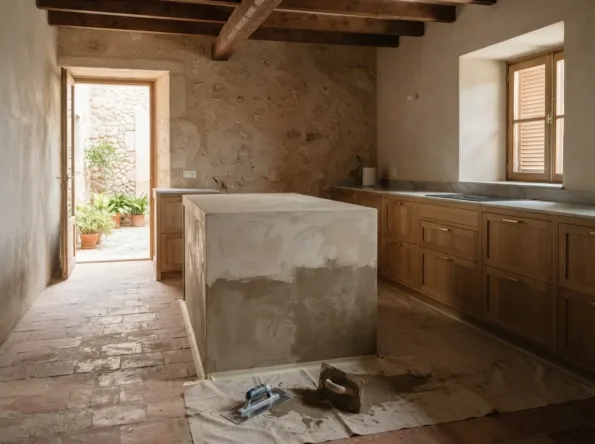
Everything depends on the applicator
Microcement is a system rather than a product: a primer, base coats, finish coats and a sealer, applied in sequence over a substrate that has to be sound, dry and stable. Where it fails, it fails because one of those was rushed: a crack in the substrate that telegraphs through, a sealer that was not given its time, an edge that was not detailed.
That makes the choice of company the whole decision. Ask to see kitchens the applicator has done, and ask to see one that is a few years old. Ask what the substrate under the worktop will be and how the edges and the sink cut-out are detailed. Ask what sealer is used, how it is maintained and how long it is expected to last before it wants doing again.
A worktop is the hardest place for microcement, because it is cut on, spilled on and cleaned every day. Many microcement kitchens here put the finish on the walls, the floor and the island sides, and a porcelain or a stone on the working top. That is not a compromise; it is the version that ages best.
Practical considerations
- Substrate first: the surface underneath has to be sound and stable, and old floors and worktops are checked before anything is promised
- Sealing decides everything on a worktop: acids, oils and heat are the enemies, and the sealer is what stands between them and the cement
- It will mark with use; the style accepts a patina, and an owner who does not should put the microcement on the walls and choose a harder top
- A house shut for the winter is kind to it; a rental with strangers and hot pans is not
- The finish is done on site over days, and the kitchen is out of use while it cures
- Price positioning: mid to high, driven almost entirely by the labour and the areas covered rather than by the material
Close to microcement
How your request reaches a company
Mallorca Kitchens is a comparison service. A request for a microcement kitchen goes to the kitchen companies and kitchen specialists on our list; they quote the work and carry it out, and any agreement is between you and the company you pick.
-
01
Describe the job
Tell us the property, roughly what you want and where it is. Photographs and a rough plan help, though neither is required.
-
02
We match it
The request goes to companies that work in your area and take on this kind of job at this size.
-
03
They quote you
Each company contacts you directly with its own price, timing and approach. We do not set any of it.
-
04
You compare and choose
Put the quotes side by side and take the one you want, or none of them. Using the site costs you nothing.
Is microcement a good kitchen worktop?
It can be, sealed well and used with some care, and it is the hardest place for it in the house. Many kitchens here put microcement on the walls, floor and island sides and a porcelain or stone on the working top, which keeps the look and gives the surface that is cut and spilled on a harder life.
Can microcement go over the existing floor or worktop?
Over a sound, stable, dry one, yes, which is one of its advantages in a renovation: no demolition. Over a cracked floor or a worktop that moves, no; the crack comes through. The applicator checks the substrate before promising.
How is it maintained?
Cleaned with neutral products, protected from standing acids and oils on a worktop, and resealed when the applicator says so. Ask that question before choosing, because the honest answers differ between systems and between applicators.
Does it suit a rental?
On the walls and the floor, yes. On the worktop, less so: strangers with hot pans and lemons are what a sealer is tested by. A porcelain top with microcement everywhere else is the usual answer for a let property.
Get microcement kitchen quotes
Say which surfaces you want in microcement and which in something harder, and let several applicators price the same kitchen.