

Is Marble Practical for Kitchen Worktops?
Key takeaways
- Marble etches with acid and marks with oil; sealing and a honed finish slow it and do not stop it.
- Owners who love it call the marks patina; owners who wanted it to stay as fitted call them damage.
- Marble on the island and something harder on the working run is how many kitchens have both.
- Porcelain and quartz marble-looks give the picture without the material.
The question comes up in almost every kitchen conversation on the island, because a Mediterranean kitchen and marble belong together in the mind. The answer depends entirely on what the person asking means by practical.
What marble does
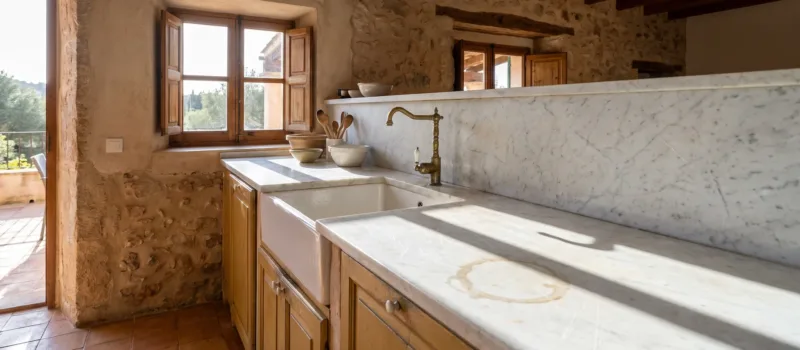
Marble is a soft, porous natural stone. Acid etches it: lemon juice, wine, vinegar and many cleaning products leave a dull mark where they sat, and a polished surface shows it more than a honed one. Oil marks it: a bottle left on the surface leaves a ring that a sealer slows but does not always stop. It scratches more easily than granite or quartz, and a hot pan is safe on it where a spilled tomato is not.
None of that is a defect. It is what the material is, and the people who choose marble knowing it are the ones who are happy with it five years later.
Who loves it, and who regrets it
| Loves it | Regrets it |
|---|---|
| Wants the veining nobody can repeat, and accepts the marks as the stone ageing. | Wanted the surface to look as it did when fitted, indefinitely. |
| Cooks with care, or does not mind the traces of cooking without care. | Has a household or guests who set down lemons and wine and do not wipe up. |
| Lives in a Mediterranean or finca kitchen where patina belongs. | Lives in a rental, or a house shut for the winter with a ring under something. |
Having marble without the worry
- Marble on the island and a harder material on the working run by the hob and the sink, where the damage happens
- A honed rather than a polished finish, which shows etching far less
- A good sealer, applied and renewed, which slows staining without pretending to stop it
- Marble as a splashback or a table rather than as the surface things are set on
- A porcelain or quartz marble-look for the working top, with real marble somewhere the eye lands
The three-way comparison sets marble against the two materials most people choose instead; the luxury page is where a bookmatched marble island belongs.
Does sealing make marble safe?
It slows staining and does nothing for etching. A sealed, honed marble is the most forgiving version of the material, and it is still marble.
Is marble a bad choice for a rental?
For the working surface, yes; guests set down lemons and wine and do not wipe up. As an island top in a villa where the rental is high-end and the owner accepts the marks, it is done.
What looks like marble and behaves better?
Porcelain and quartz both come in convincing marble looks, from a metre away. At the edge the print stops and the body shows, which a mitred edge hides.
This might be interesting to you
The Best Kitchen Layouts for Mallorca Villas
Galley, L, U or island: which layouts work in a villa that opens onto a terrace and entertains for e...
Quartz vs Marble vs Porcelain Worktops: Which Suits a Mallorca Kitchen?
The three materials most kitchens here choose between, compared on what matters on the island: sun, ...
The Complete Guide to Kitchen Renovation in Mallorca
From the first measurement to the snagging visit: how a kitchen renovation on the island actually ru...
Microcement Kitchens: The Pros and Cons
Seamless, warm and Mediterranean, and entirely dependent on who applies it. Where microcement earns ...